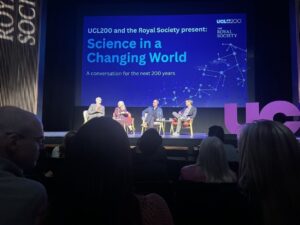

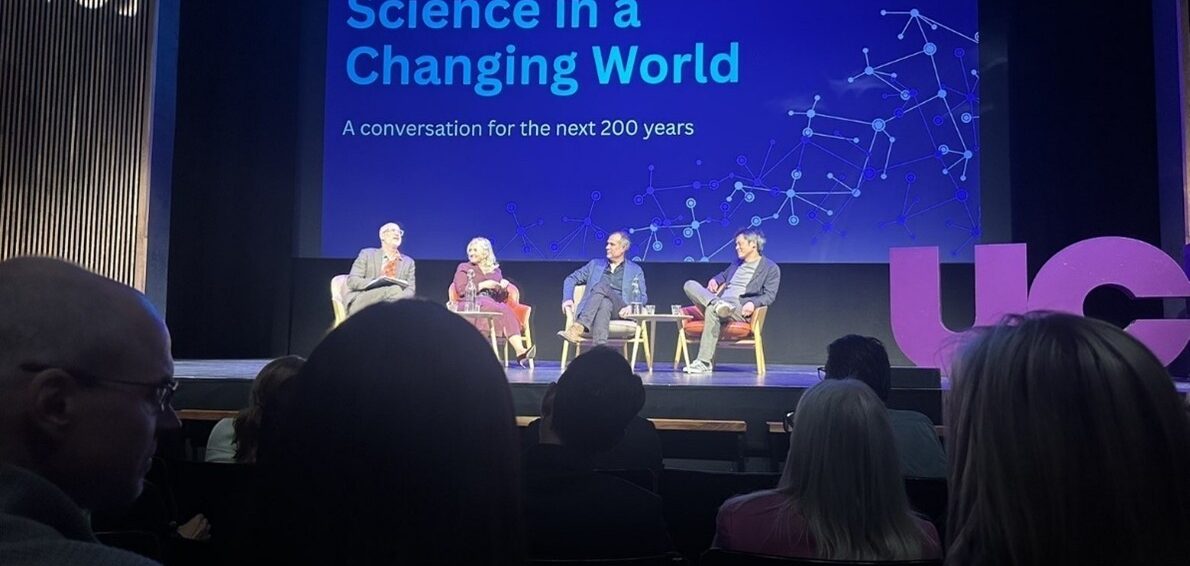
Recently, one of our Year 12 students, Apurwaa, had the exciting opportunity to attend the Royal Society’s Science in a Changing World event. Bringing together leading scientists and thinkers, the event explored how science is helping to address some of the most pressing challenges facing our planet today. From climate change to technological innovation, it offered a fascinating insight into the role of science in shaping our future.
Below, she shares her reflections and highlights from this inspiring experience:
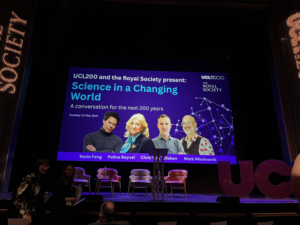
In 1660, Sir Robert Boyle set out his predictions for the future of science over the next 200 to 300 years. Of those predictions, many of them have since become a reality from “The Art of Flying” and “A ship to sail with All Winds” (aircraft and modern shipping), to organ transplantation and methods to appease pain. Boyle himself was an original Fellow of the Royal Society. On Tuesday the 12th of May, I had the pleasure of attending a discussion titled Science in a Changing World presented by University College London and the Royal Society as part of UCL’s 200th birthday celebration. The conversation explored what the next 200 years holds, much like Boyle did centuries ago.
The panel consisted of Mark Miodownik MBE (Chair), material scientist, engineer, broadcaster and award-winning author known for making complex ideas accessible; Dame Polina Bayvel, a leading figure in optical communications research whose work underpins modern digital communication and AI Infrastructure; Kevin Fong, a doctor and broadcaster whose work spans emergency medicine, astrophysics and space exploration; and Chris Van Tulleken, a doctor, scientist and author focused on medicine, nutrition and public health
The evening started off by talking about the future of space travel and the question that’s on everyone’s mind: will humans go to Mars? Although it always seems to be “20 years away”, the panel agreed that it is certainly possibility. We are currently in the most exciting era for space travel since the Apollo missions. The challenge was compared to that of early North Pole expeditions, it seemed like something completely unattainable with a 50% mortality rate but now achievable. Challenges surrounding it such as communication technology were also discussed, highlighting that the Artemis II mission was the first crewed space mission to use optical communications to send data back to earth. Ultimately, the main consideration was to make missions to Mars economically sustainable and accessible.
Continuing with communication technology, transatlantic cables were once a dream by Victorians, funded by public investment to make it become a reality. Since then, communication has gone from 1 bit per second to 1 petabyte. However, the increasing use of AI is adding traffic and adding strain on existing infrastructure. More data has been sent in the past 4 years than in the past 40 years. The main takeaway from this is that telecommunications networks must become more resilient as our current infrastructure will simply not be capable of handling future demand. New types of optical fibres may be necessary. Quantum communication was also discussed, while it offers exceptional security, it remains relatively slow. There was even speculation that brain chip technology could eventually be normalised allowing person to person communication and even person to robot without the need for traditional devices.
Food and nutrition also formed a major theme of the discussion. The idea that humans may one day survive on nutrient pills alone was quickly dismissed by Dr Chris Van Tulleken. We were reassured that deliciousness will not be disappearing either. He emphasised that there are some aspects of the past that we don’t need to let go of without fearing that it will hinder progress. Food is something that is complex, it is more than fuel and a building material, it is also community and culture. Life depends on consuming other life, and food nourishes both our physical and social wellbeing. So rather in the next 200 years, what we should focus on is growing food insecurity, producing food at scale without waste and loss of biodiversity. We should help prevent pollution and antimicrobial resistance and increase animal welfare standards. The panel also highlighted the importance of the physical act of eating itself – even chewing plays an important role in health. Another interesting point was the distinction between liking food and wanting it, and how consumer demand shapes the food industry.
So, with better nutrition, will we live significantly longer? Probably not. At least not without any sort of artificial augmentation. Current trends suggest that while lifespans may increase slightly there is likely an upper bound of around 120 years. Extending health span, the years spent in good health, appears to be more realistic than dramatically extending lifespan itself.
The discussion then widened to science as a whole and how progress can continue in the future. An issue raised was that science tends to often be hidden within academic circles and are not shared effectively with the public. The panel argued that science must become more accessible in order to inspire future generations and to maintain public trust. They also emphasised the importance of “Big Science” which is large scale scientific collaboration that benefits society. However, progress is often limited by a lack of coherence and cooperation. Scientific advancement should ultimately benefit everyone and not only those in wealthier societies. The panel stressed that equality in science is essential, especially as many inequalities are already becoming more visible across the world. Public trust in science is now more important than ever.
Interestingly, despite its dominance in modern conversations, AI was not discussed as heavily as I expected. Nevertheless, the panel acknowledged that AI will inevitably shape the future and at least for the coming decades, it will increase inequality. History has seen the patterns before during technological revolutions, such as the invention of the power loom in the 18th century, which displaced thousands of workers while transforming society.
So, perhaps we can create our own prediction for the next two centuries:
- Humans will eventually travel to Mars
- Complexity is our challenge and it will continue to increase, constantly changing how humans will live, so the humanities and arts will become even more important in scientific discussion
- Food will continue to be enjoyable and meaningful – not replaced by pills.
- We will move closer to achieving fusion energy
- More people may live to 100 years old, with improved quality of life
The evening ended with a powerful message: there is nothing to fear in science. It is always better to know than to not know. Science is fundamentally multidisciplinary built by the constant cycle of conjecture, questioning and asking and true scientists must possess both fearlessness and humility, having the courage to explore new ideas and the willingness to question and learn continuously.
On a personal note, what stood out to me the most was the importance of communication. While all the speakers are experienced science communicators, I was particularly in awe of their ability to engage with such a wide-ranging audience – from year 12 students like myself to other leading academics in the room. They showed how essential public understanding and trust are to the future of science. The evening reminded me that scientific progress isn’t just about discovery; it also involves making knowledge accessible and understandable.